Showing posts with label asteroid. Show all posts

Friday, June 22, 2012

Not with a Bang, but a Whimper?

If we could somehow disassociate ourselves from ourselves and all we are, and stand well back away from this planet earth, and hit the rewind button on our remote, taking the planet back through time (whatever that is) to its inception, and then fast forward to the present, we'd be struck by what a dynamic planet the earth is, changing constantly in fits and starts, or more accurately, eruptions, explosions, and earthquakes, in fire and in ice.

In earlier posts I've written about the earth's five mass extinction events, and the hypothesis of many scientists today that we are in the midst of a sixth mass extinction event. In examining this hypothesis, scientists have to ask themselves, what caused the first five extinctions? And then, are we seeing similar conditions now? As you might have guessed, there are no easy answers.

It's important to understand what a "mass extinction" means, and how an "event" is defined. Because we ordinary humans have no understanding of time in a geologic sense (unlike rocks), we need to know that an event in paleo terms can occur over millions of years -- there's no agreement on how many millions of years.

A mass extinction is a loss of biodiversity -- plants and animals -- that exceeds what is considered "normal," that is, things becoming extinct as an expected result of evolution, otherwise known as "background" extinction. Thus, an extinction event is a dramatic loss of plant and animal life that occurs rapidly in geologic terms.
There have been a variety of singular events hypothesized as the cause of one or another mass extinction event. Perhaps the best known extinction event and its hypothesized cause is the so-called K-T extinction, named for the timing of the event, the boundary between the end of the Mesozoic -- the Cretaceous era -- and the beginning of the Tertiary period, 65 million years ago. This boundary event marked the end of the dinosaurs, and since most of us at one time or another have been fascinated by these gigantic, strange and fearsome looking creatures, it's no wonder this particular extinction event has generated so much popular interest.
But not just dinosaurs died off in the K-T extinction. Almost all the large vertebrates on Earth, on land, at sea, and in the air became extinct by the end of the Cretaceous Period, and most plankton and many tropical invertebrates, especially reef-dwellers, became extinct. Many land plants were severely affected. Thus, the earth in all its manifestations was a very different place after K-T. Why? What happened?

Many scientists -- paleontologists, biologists, geologists, etc. -- came to believe that a large asteroid impacted the earth at that time, causing widespread devastation and triggering catastrophic global climate change. In fact, a crater has been discovered; an egg-shaped geological structure called Chicxulub, deeply buried under the sediments of the  of Mexico (North America looked like this  65 million years ago). Some scientists insist the asteroid creating the crater impacted earth exactly 65 million years ago.

Other scientists argue the Chicxulub impact predated the K-T boundary by some 300,000 years, and propose that volcanism actually caused the mass extinction. The volcanism theory centers on the so-called Deccan Traps, flood basalts similar to the Columbia River basalts of the northwestern United States. This is one of the largest volcanic provinces in the world. It consists of more than 2,000 meters of flat-lying basalt lava flows and covers an area of nearly 500,000 square km (roughly the size of the states of Washington and Oregon combined) in west-central India. Estimates of the original area covered by the lava flows are as high as 1.5 million square km. The volume of basalt is estimated to be 512,000 cubic km (the 1980 eruption of Mount St. Helens produced just 1 km3 of volcanic material).

More recently, some scientists have come to the conclusion that it was a combination of meteor strikes and massive volcanic activity that brought about the K-T mass extinction event. What seems more likely to me at least, is that over several million years, the world, rife with erupting volcanoes, became less and less hospitable for its terrestrial and marine guests. Vast amounts of dust, carbon dioxide, and sulfur dioxide poured into the atmosphere, resulting in heavy acid rain (akin to battery acid), acidic oceans, and global temperatures that initially turned frigid (possibly lasting for years) due to dust and debris, and then intolerably hot, due to the longer-term green house effects of carbon dioxide. Violent tornadoes and hurricanes ravaged the earth, the seas fell and then rose, inundating coastal areas, normal food supplies dwindled and what was left was gobbled up by the more adaptable life forms that managed to survive the initial onslaught, such as the plankton species Guembelitria cretacea, a disaster opportunist that flourished in devastated environments when few other species survived.

Chicxulub may have looked like this. This is
actually 951 Gaspra, a much larger asteroid.
And then Chicxulub made its abrupt and violent (100 million megatons equivalent) arrival on the Yucatán peninsula creating a tipping point for the vulnerable planet and spelling an end to life as it existed 65 million years ago.

Friday, June 15, 2012

Asteroid 2012 LZ1

What if it hit the earth?

An asteroid the size of a city block flew by Earth today, June 13, 2012, “Flag Day.” The near-Earth asteroid named 2012 LZ1, which astronomers think is about 500 meters wide, will come within 5,381,600 kilometers (14 lunar distances) of Earth this evening; far enough away not to worry. We left the flag out and enjoyed a balmy evening.
Asteroids have collided with the earth in the past. Some scientists believe it was an asteroid impacting the earth that led to the last mass extinction event; the one 65 million years ago (the K-T extinction event) that wiped out the dinosaurs, along with most other land and marine life. That asteroid was estimated to be 15 kilometers wide; 30 times larger than 2012 LZ1. It slammed into the earth with a force one billion times more powerful than the atomic bomb that leveled Hiroshima. Proportionally, if an asteroid the size of 2012 LZ1 did hit the earth, it would only hit with a force about 16 or 17 million times that of the Hiroshima atomic bomb.

A relatively large meteorite (40 meters in diameter) hit the earth in what is now Arizona about 50,000 years ago during the late Pleistocene era. It is estimated that the meteorite had the density of iron (7870 kg/m3), weighed about 300,000 tons, and was traveling with a velocity of 12 to 20 km/s (27,000 to 45,000 mph).


The Arizona landscape was cooler and wetter than it is today. The plain around it was covered with a forest, where mammoths, mastodons and giant ground sloths grazed. The force of the impact would have leveled the forest for miles around, hurling the mammoths across the plain and killing or severely injuring any animals nearby. Global effects were negligible.

I calculated the potential effects of the much larger 2012 LZ1 asteroid impacting the earth by using Purdue University’s  Impact Earth on-line tool. I used the following parameters:
  • Diameter: 502.3 m
  • Density: 3000kg/m3 (dense rock)
  • Angle of impact: 60 deg
  • Velocity: 17 km/s (38,000 mph)
  • Target: Sedimentary Rock
  • Distance: 65 km (40 miles)
S. Nelson, Tulane U., 11/16/11
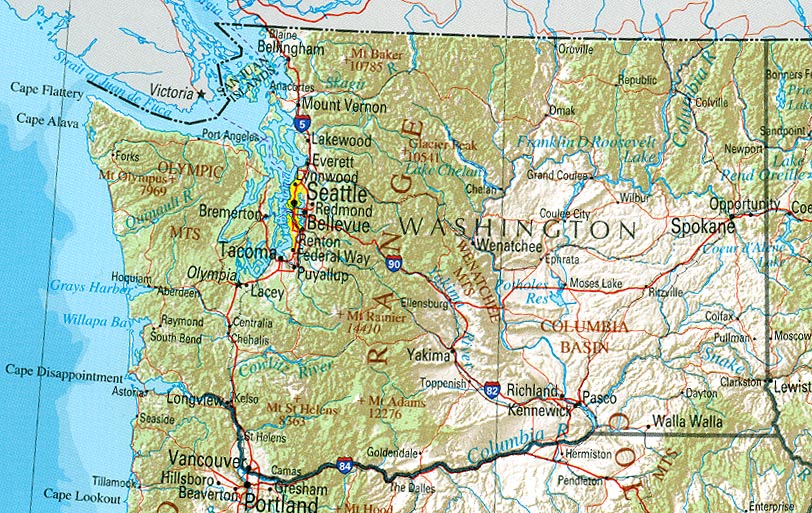
I have the projectile impacting in an area between and approximately equidistant (40 miles) from Richland, Ellensburg, and Moses Lake, Washington. According to the Impact Earth calculations and my parameters, 2012 LZ1 strikes the earth with an impact equivalent to 6,700 megatons of TNT. It creates a crater 5.25 miles in diameter and 1850 ft deep. In Richland, Ellensburg, and Moses Lake, thermal radiation from the blast will arrive in mere milliseconds after impact. The fireball will be visible for almost 4 miles and appear 20 times larger than the sun. Thermal exposure is equivalent to thousands of degrees Fahrenheit.


People in this zone will suffer third degree burns over much of their body. The ejecta from the impact will arrive in less than 2 minutes, the blast wave in 3.25 minutes. Wind velocity will reach 237 mph. The sound intensity will be 95 dB. Multistory wall-bearing buildings will collapse. Wood frame buildings will be destroyed. Glass windows will shatter. Up to 90% of trees will be burned and/or blown down and the remainder will be stripped of leaves and branches. In Seattle and Portland, some 400 miles away, the impact will feel like a 7.2 magnitude earthquake. A fine dusting of particles and some larger fragments will fall on the cities.

The impact would put large quantities of dust into the atmosphere, blocking incoming solar radiation. Wildfires would be widespread, putting more dust, as well as smoke into the air. The dust could take months to settle back to the surface.  Meanwhile, the region would be overcast and dark, and temperatures would drop. This would result in a drop in temperatures.

Blockage of solar radiation would also diminish the ability of plants to photosynthesize, seriously disrupting agriculture, which might take years to recover. If the asteroid impacted in the Columbia River, the consequences would be even more catastrophic (for the purposes of this essay, I am not addressing the remote possibility of the asteroid impacting in the Hanford Nuclear Reservation, the consequences of which would be dire, but essentially unknowable).
On a global scale, the earth would not be strongly disturbed by the impact and would lose negligible mass. The impact would not make a noticeable change in the tilt of earth’s axis, nor would it shift the earth’s orbit noticeably. Climate consequences would most likely be regional or continental, rather than global.

September 11, 2001 Re-imagined Redux

Back in May, President Trump abruptly dismissed "dozens national security advisors from US National Security Council (NSC). NPR reporte...